The time of Isha enters when the last glow of dusk has gone, and the four schools hold that it is best prayed within the first third of the night. Most scholars hold that it remains valid until true dawn, though they differ on how late it may be delayed without an excuse.
The middle of the night, which some scholars take as the end of Isha's time, is halfway between Maghrib and Fajr, not 12:00.
What time does Isha start and end tonight?
Pick a city, or use your location, to see tonight's Isha times where you are:
London · 21 December 2026
London Unified Prayer Timetable
See prayer times today for the other prayers and a full month. For accurate prayer times wherever you are, Pillars chooses the right calculation method for your location and updates it as you travel.
When does Isha start?
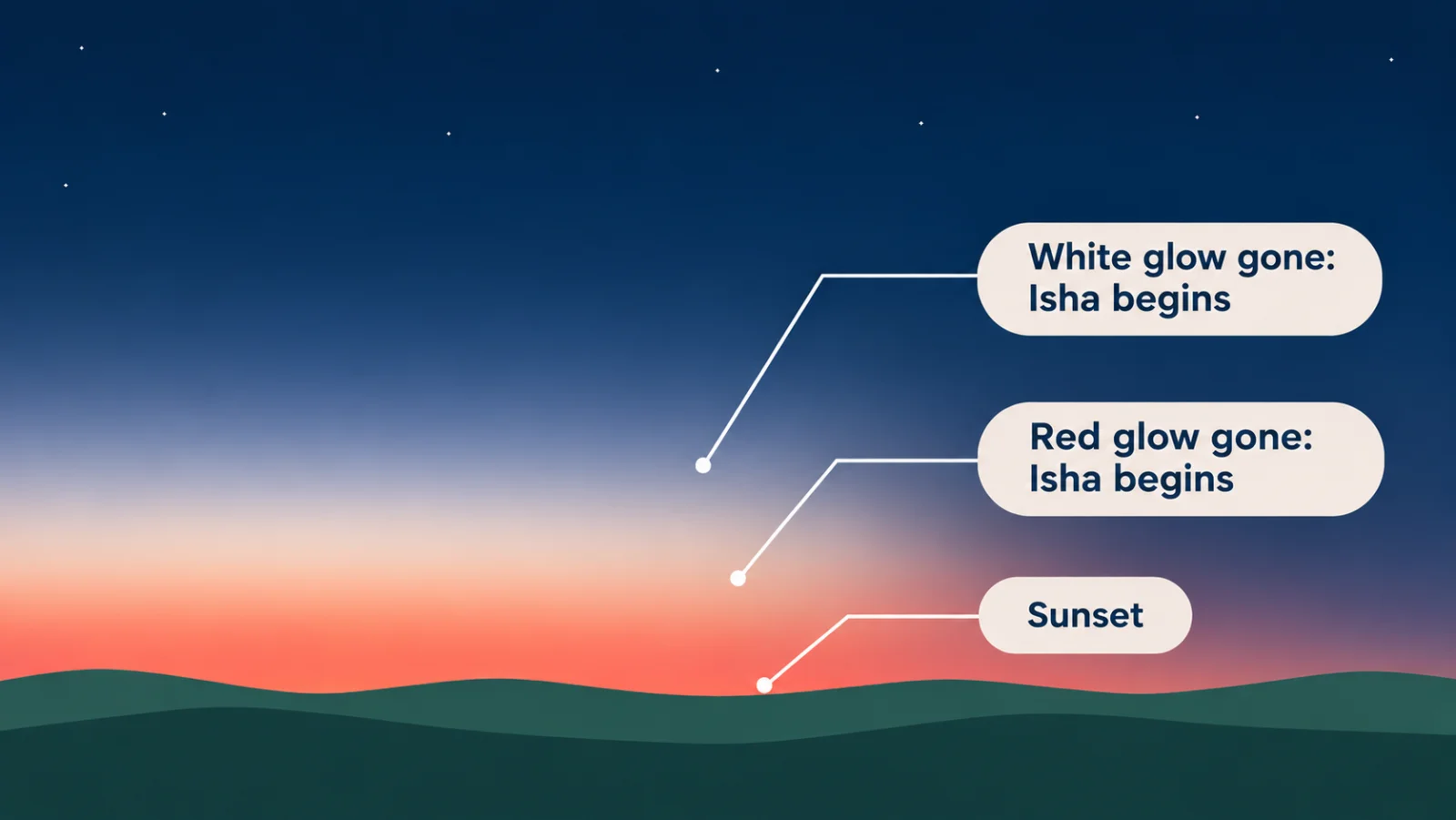
The time of Isha enters when the twilight left by sunset, the shafaq, has disappeared, and with it the time of Maghrib ends. The schools differ on which glow is meant:
- The Shafi'i, Maliki and Hanbali schools hold that Isha enters once the red glow has gone.
- The Hanafi school, in the position of Imam Abu Hanifa, holds that it enters once the white glow that follows has also gone, which is later. His two students, Imam Abu Yusuf and Imam Muhammad, held that it is the red glow.
Timetables express this as the angle of the sun below the horizon, usually between 15° and 18°. A larger angle means a later Isha. Umm al-Qura instead sets Isha 90 minutes after Maghrib. For why the angles differ, read how prayer times are calculated. Here is tonight's Isha under each method, and the middle of the night each one gives:
| Timetable or method | Isha | Middle of the night |
|---|---|---|
| London Unified Prayer Timetable | 17:34 | 23:08 |
| Muslim World League | 17:51 | 22:55 |
| ISNA (North America) | 17:38 | 23:05 |
| Egyptian General Authority of Survey | 17:54 | 22:50 |
| Umm al-Qura (Makkah) | 17:23 | 22:54 |
| Moonsighting Committee | 17:32 | 23:08 |
| Gap between methods | 31 min | 18 min |
When does Isha end?
The scholars derive the end of Isha's time from three hadith:
- In Sahih Muslim 612, the Prophet ﷺ said that the time of Isha lasts "until half of the night has passed".
- In Jami' at-Tirmidhi 149, Jibril led the Prophet ﷺ in Isha on the second day when a third of the night had passed.
- In Sahih Muslim 681, the Prophet ﷺ said that negligence lies in not praying a prayer "till the time of the other prayer comes". Imam an-Nawawi took this as evidence that Isha remains valid until Fajr.
The four schools reconcile these texts, and most distinguish a chosen time, in which it is best to pray, from a later time in which Isha is still valid. Their positions, as recorded in al-Mawsu'a al-Fiqhiyya, are:
- Hanafi
Isha remains valid until true dawn. Al-Shurunbulali records in Maraqi al-Falah that delaying it until about a third of the night is recommended, up to half is permitted, and beyond half is disliked. The jurists give the reason that a later Isha reduces the congregation, so, as Ibn 'Abidin relates from Khayr al-Din al-Ramli, the dislike does not apply to someone praying alone, nor to someone with an excuse. - Maliki
In the well-known view of the school, the time of Isha ends with the first third of the night. Ibn Rushd also reports a view from Imam Malik extending it to the middle of the night, and a less-known view in the school extends it to dawn. - Shafi'i
Ibn Rushd reports that for Imam ash-Shafi'i the chosen time ends with the first third of the night, and Isha remains valid until true dawn. - Hanbali
The chosen time ends with the first third of the night. After it comes a "time of necessity" until dawn, for cases such as a sick person who recovers. Al-Mardawi states in al-Insaf that delaying Isha into this time without a valid excuse is forbidden.
Among contemporary scholars, Shaykh Ibn Baz held in his Majmu' Fatawa that Isha must be prayed before the middle of the night, keeping to the wording of the hadith in Sahih Muslim 612.
What does "the middle of the night" mean?
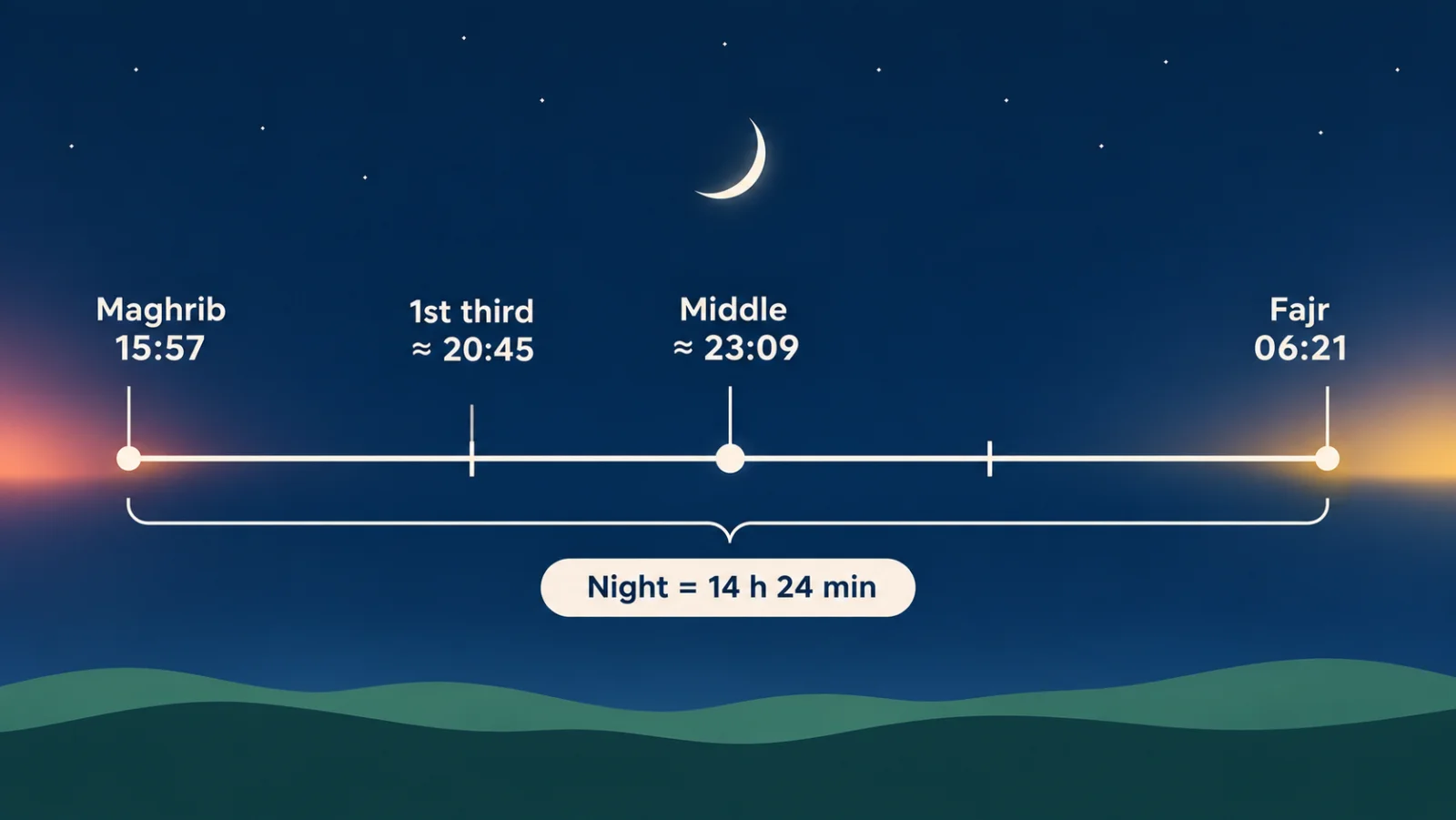
It is the halfway point between Maghrib and Fajr, not 12:00. In fiqh, the night is counted from the entry of Maghrib to the entry of Fajr, so its middle moves through the year.
To find it, take the length of the night and divide it. For example, in London on 21 December 2026:
- Maghrib: 15:57
- Fajr the next morning: 06:21
- Length of the night: 14 hours 24 minutes
- First third of the night ends: 15:57 + 4 hours 48 minutes, about 20:45
- Middle of the night: 15:57 + 7 hours 12 minutes, about 23:09
Some timetables halve the time from sunset to sunrise instead. That puts the middle of the night later, by about an hour in London in December.
Why can Isha start so late in a UK summer?
In June and July, the sky never gets fully dark in much of Britain. HM Nautical Almanac Office notes that the sun "does not reach 18°" below the horizon in many parts of the British Isles, so the angle Isha is calculated from may never arrive.
Timetables then use a high-latitude rule, which places Isha using a share of the night instead. Each rule gives a different Isha and a different Fajr, so the middle of the night moves too, and in summer it is worth checking which rule your mosque's timetable uses. With the middle-of-the-night rule, Isha in London is calculated for 01:02, after the middle of the night:
| High-latitude rule | Isha | Middle of the night |
|---|---|---|
| Middle of the night | 01:02 | 23:11 |
| One-seventh of the night | 22:25 | 00:30 |
| Twilight angle | 23:27 | 23:55 |
How do I make sure my Isha time is right?
Start with your mosque, then match your app to it.
- Check your local mosque's timetable
If your mosque publishes one, use it as your reference. - Match the method
Isha angles range from 15° to 18°, so try methods until a week of Isha times lines up with your mosque's. - Match the high-latitude rule
Far from the equator, this decides Isha in summer (in the UK, from May to August). - Adjust if needed
Add or take away a few minutes to match the extra minutes of caution some mosques add.
In Pillars, all of this is in Settings, under Prayer Times:
- Autopilot
On by default. It picks a valid calculation method for the country you are in, and changes it as you travel (in supported countries). - Calculation method
Turn Auto-Detect off to choose your own from 23 methods, each listed with its Fajr and Isha angles. - High-latitude rule
Twilight angle, middle of the night or one-seventh of the night. - Custom angles
Set your own angle for Isha, from 9° to 18.5°. - Custom adjustments
Move Isha a few minutes earlier or later to match your mosque.
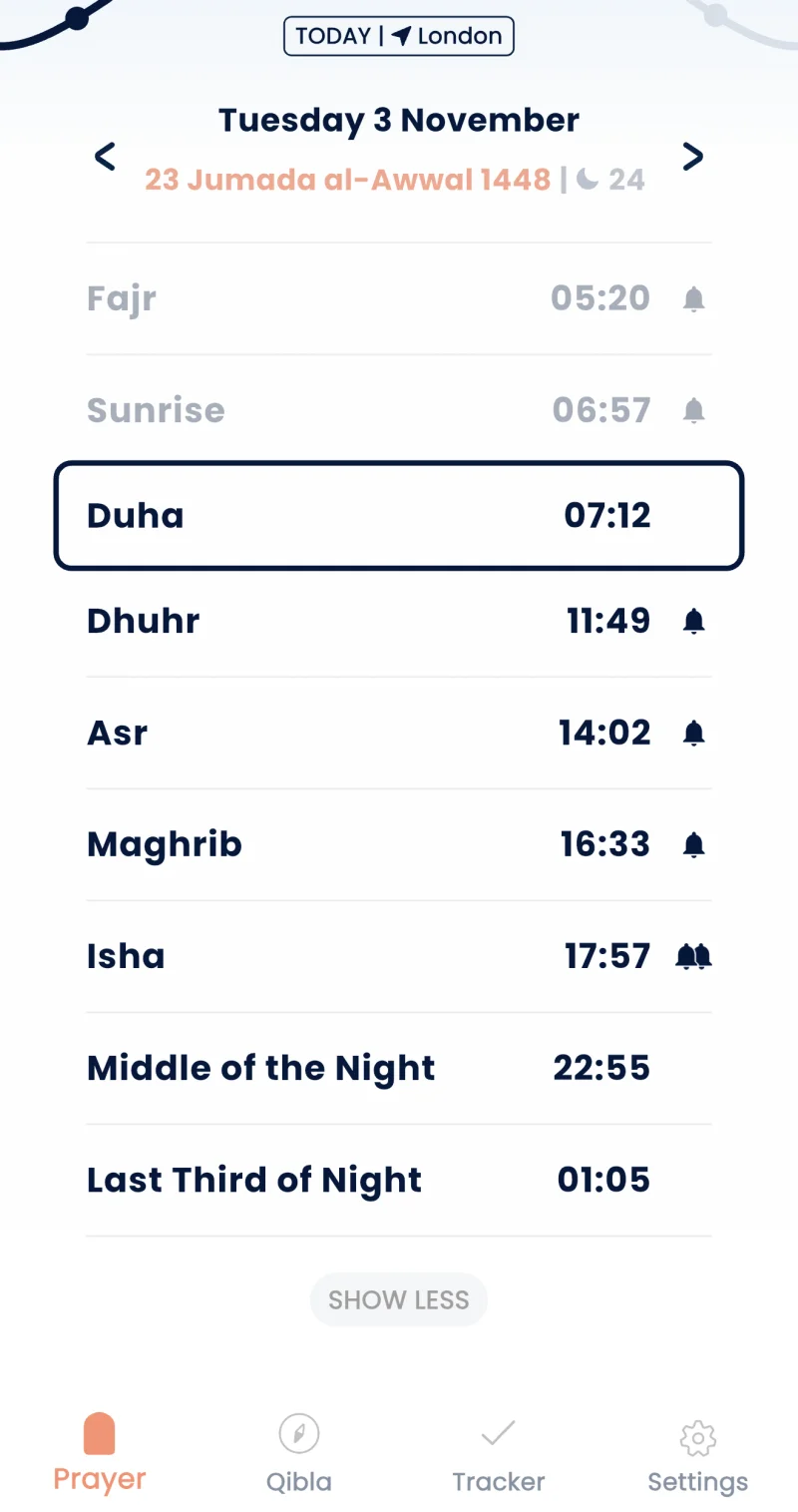
Pillars also shows the middle of the night and the start of the last third of the night, both measured from Maghrib to Fajr.
Keep reading