Fajr starts at true dawn, when light first spreads along the horizon, and ends at sunrise. Common calculation methods place true dawn when the sun is between 12° and 19.5° below the horizon, so times differ. In London on 21 December 2026, calculated Fajr ranges from 05:49 to 06:40; sunrise is 08:04.1, 2
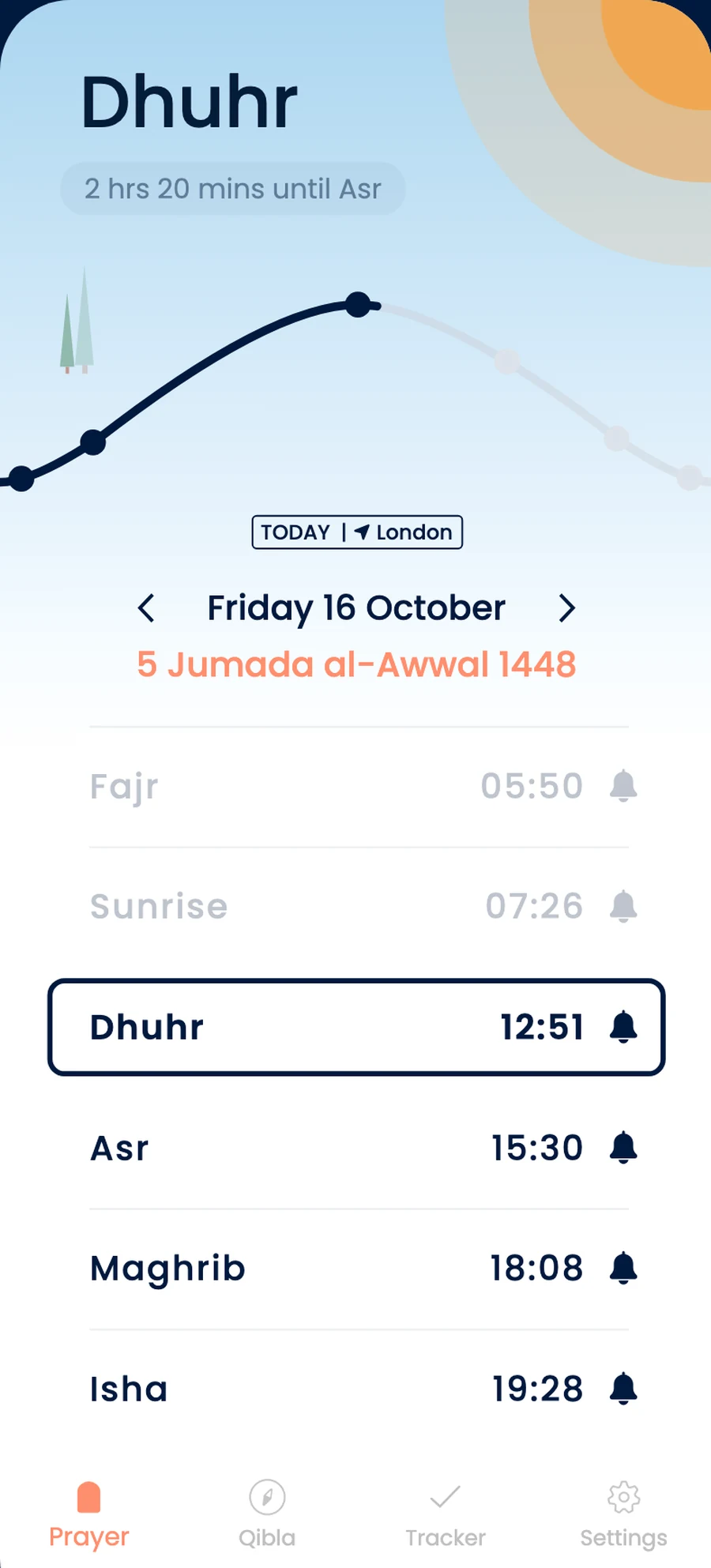
Today, where you are: check your mosque's timetable first. An app set to your mosque's method, such as Pillars, our app, can show today's Fajr for your location.3
What is true dawn, and what is false dawn?
True dawn (subh sadiq) is a horizontal band of light along the horizon that keeps growing brighter. False dawn is a vertical glow that fades, with darkness beneath it. Fajr is tied to true dawn only.4, 5
In Sahih Muslim 1094, the Prophet ﷺ said that neither Bilal's call "nor this whiteness" should mislead people "until it spreads".4 Ibn Qudamah reports consensus that the rulings attach to true dawn (via IslamQA).5
HM Nautical Almanac Office says "there is no general agreement on a precise definition of 'dawn'". It places dawn somewhere between 18° and 12° below the horizon.6 So methods use different angles:
| Method | Fajr angle |
|---|---|
| Muslim World League (MWL) | 18° |
| ISNA (North America) | 15° |
| Egyptian General Authority of Survey | 19.5° |
| Umm al-Qura (Makkah) | 18.5° |
| UOIF (France) | 12° |
| Moonsighting Committee | No fixed angle: a seasonal model fitted to observations |
[IMAGE: Sun angle below the horizon by Fajr method]
When does Fajr end?
Fajr ends at sunrise, when the first edge of the sun appears. Sahih Muslim 612 gives its time "from the appearance of dawn, as long as the sun has not risen".9 Sahih al-Bukhari 579 says whoever catches one rak'ah before sunrise "has got the (morning) prayer".10
Sunrise is calculated for the sun's centre at 0.833° below the horizon, allowing for refraction and the sun's size. HMNAO expects differences "of a minute or so".6 Some timetables add a margin: East London Mosque publishes sunrise 3 minutes before HMNAO's figure.11
How long does Fajr last in the UK?
For most of the year, about 1½ to 2 hours, depending on method and season. The "70 to 90 minutes" figure seen online is too short for the common methods in Britain, which give about 93 minutes at the shortest.2
Calculated time from Fajr to sunrise in London (calculated with the open-source adhan-js library; middle-of-the-night rule except where stated; the Moonsighting Committee uses its own model):
| Date | MWL 18° | ISNA 15° | Moonsighting Committee |
|---|---|---|---|
| 21 Dec 2026 | 2 h 04 min | 1 h 44 min | 1 h 42 min |
| 20 Mar 2027 | 1 h 53 min | 1 h 33 min | 1 h 33 min |
| 22 Sep 2027 | 1 h 54 min | 1 h 33 min | 1 h 33 min |
| 21 Jun 2027 | 2 h 13 min (twilight-angle rule) | 1 h 50 min (twilight-angle rule) | 2 h 00 min |
2
Lower angles shorten the window: UOIF's 12° gives about 1 h 13 min in March. In June, the one-seventh rule gives just 1 h 03 min.2 East London Mosque's published table gives 1 h 37 min on 1 January 2026.11
Why is Fajr so early in a UK summer?
Because the sky never gets fully dark, so the time depends on a rule, not the sun's angle. HMNAO notes that in June and July the sun does not reach 18° below the horizon "in many parts of the British Isles".6 In our calculations for 21 June 2027, it never reaches 18° in any of six UK cities.2
Calculators apply a high-latitude rule, which estimates Fajr from the length of the night:
- Middle of the night: Fajr no earlier than halfway between sunset and sunrise.
- One-seventh: Fajr at the start of the last seventh of the night.
- Twilight angle: Fajr no earlier than a fraction of the night before sunrise, set by the angle (18° gives 18/60, or about a third of the night).
On 21 June 2027 in London, calculated MWL Fajr is:
| High-latitude rule | Fajr |
|---|---|
| Middle of the night | 01:02 |
| Twilight angle | 02:31 |
| One-seventh | 03:40 |
| Sunrise | 04:43 |
2
That is a 2 h 38 min spread across methods and rules on one night.2 Wifaqul Ulama uses 18° and, during persistent twilight (summer nights when the sky never gets fully dark), either the nearest day when 18° occurred or half the night, "not both".12 The London Unified Prayer Timetable uses Khalid Shaukat's observation-based model.13
[IMAGE: Fajr in London on 21 June by rule]
What time is Fajr in London through the year?
Calculated Fajr in London by method (middle-of-the-night rule; in June the MWL and Egypt times are set by that rule, not the angle; the Moonsighting Committee uses its own seasonal model):
| Date | MWL 18° | ISNA 15° | Egypt 19.5° | Moonsighting Cttee | Sunrise |
|---|---|---|---|---|---|
| 21 Dec 2026 | 05:59 | 06:20 | 05:49 | 06:22 | 08:04 |
| 20 Mar 2027 | 04:11 | 04:31 | 04:00 | 04:31 | 06:04 |
| 21 Jun 2027 | 01:02 | 01:15 | 01:02 | 02:43 | 04:43 |
| 22 Sep 2027 | 04:52 | 05:13 | 04:41 | 05:13 | 06:46 |
2
Outside the summer months, the six methods we checked (including UOIF's 12°) differ by about 51 minutes in London.2 Further north, on 21 December 2026, MWL Fajr is 06:08 in Birmingham and 06:24 in Glasgow.2
Method note: calculated with adhan-js 4.4.6; every method except the Moonsighting Committee was cross-checked with praytimes 2.3.2, and Fajr agrees within half a minute. City-centre coordinates. These are calculated values, not any mosque's official timetable.2
Does Fajr time mark the start of the fast?
Yes. The fast runs from Fajr to Maghrib, so Fajr is when suhoor ends.2 So in Ramadan, your method decides when you stop eating. By the calculated Umm al-Qura calendar, Ramadan 1448 would begin on 8 February 2027, subject to moonsighting. On that day, calculated London Fajr is 05:34 under MWL and 05:53 under ISNA.2 Your mosque's timetable gives the suhoor time it follows.
What do scholars say about Fajr's start, end and best time?
| Point | View | Held by / source |
|---|---|---|
| Start | True dawn, not false dawn | Consensus reported by Ibn Qudamah5; Muslim 10944; Ayatollah Khamenei, Rule 414 |
| End | Sunrise | Muslim 61215, 9; Bukhari 57910; Ayatollah Khamenei, Rule 414 |
| Range shown to the Prophet ﷺ | Jibril led the Prophet ﷺ in Fajr once at first dawn and once when "the land glowed"; the time is "between these two times" | Jami' at-Tirmidhi 14916; moonsighting.com notes "great leeway"7 |
| Early vs later in the window | The majority (Maliki, Shafi'i and Hanbali scholars): early, in the dark after true dawn (taghlis). The Hanafi school: later, once the sky brightens (isfar), with time left before sunrise. | Jordan Iftaa, citing al-Nawawi17; Ibn Qudamah via IslamQA18; SeekersGuidance19 |
All agree Fajr is valid any time before sunrise; they differ only on which part is better.17 Hanafis cite Tirmidhi 154: "Perform Fajr at Al-Isfar, for indeed its reward is greater."20, 19 The majority cite Bukhari 578: after Fajr, women went home and "nobody could recognize them because of darkness".21, 18 They read isfar as dawn being clearly in, not as delay.20, 17
These are views, not rulings. Ask your local mosque or a scholar you trust which view they follow.
Why does my app differ from my mosque?
Usually because the app uses a different method, high-latitude rule or margin. On 20 October 2026, East London Mosque publishes Fajr at 05:57.11 The Moonsighting Committee model gives 05:57 too. MWL with the twilight-angle rule gives 05:41.13, 2
East London Mosque itself says "ALL timetables can only give an approximation for Fajr times", and advises following your local mosque.11 Our explainer covers each method. how prayer times are calculated
How to set Fajr correctly in an app
Most apps have similar settings; match them to your mosque:
- Calculation method: Pillars offers 23 methods, plus autopilot, which picks one from your country.3
- High-latitude rule: choose twilight angle, middle of the night or one-seventh. In the UK this sets summer Fajr.3
- Manual adjustment: shift any single prayer by up to 60 minutes either way.3
- Mosque timetable: on iPhone, Pillars can show the published times of mosques it covers; check whether yours is listed.3
Compare a week of your mosque's times first. Pillars prayer times app
Keep reading