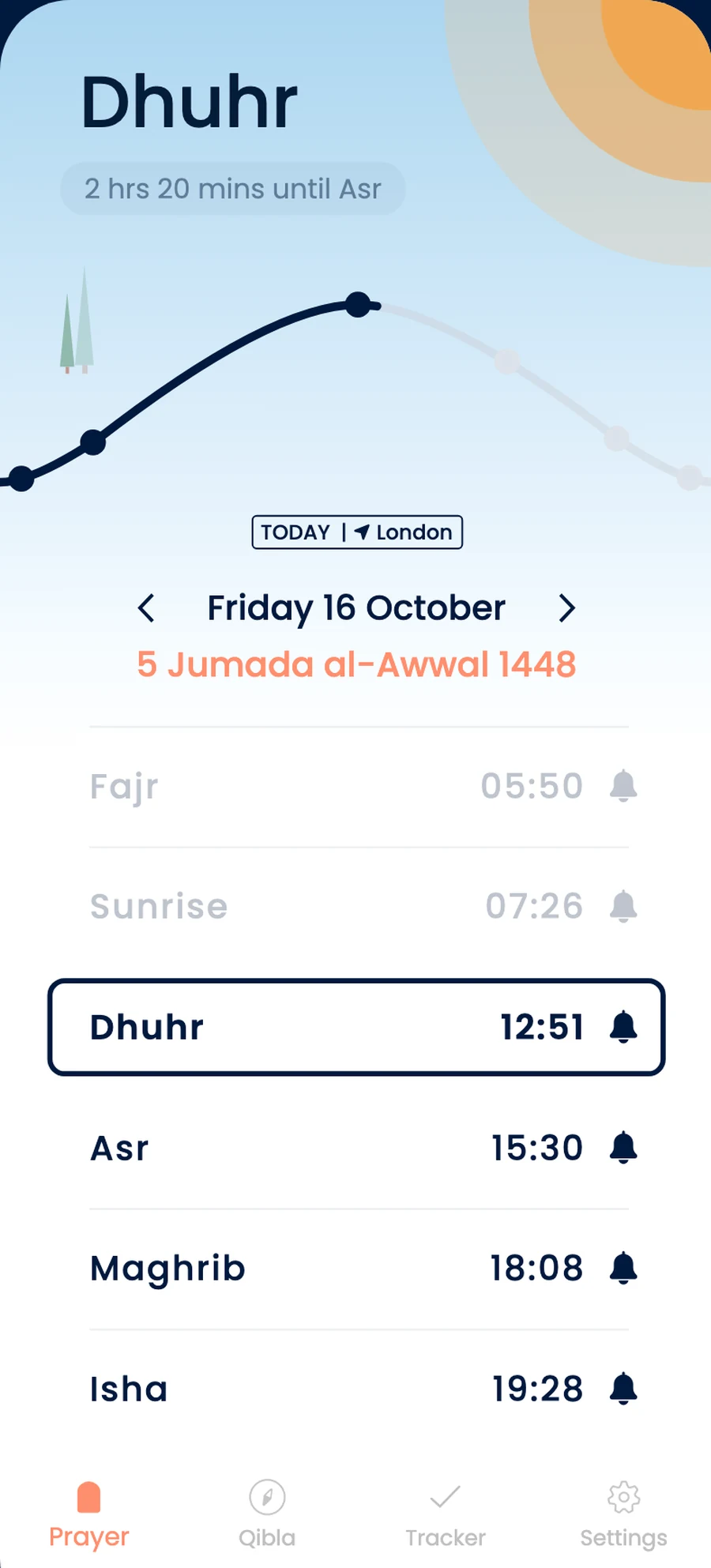
Asr is the afternoon prayer, the third of the five daily prayers. In the majority view, the time of Asr enters when an object's shadow equals its length, plus the shadow it cast at midday. The Hanafi school holds that it enters when the shadow reaches twice the object's length, plus the midday shadow. The time for Asr ends at sunset.
Shadows grow at a different pace through the year, so the clock time of Asr moves with your city and the season. That is also why many timetables show two Asr times.
What time does Asr start today?
Pick a city, or use your location, to see today's times where you are:
London · 21 June 2027
London Unified Prayer Timetable
See prayer times today for the other prayers and a full month. For accurate prayer times wherever you are, Pillars chooses the right calculation method for your location and updates it as you travel.
How is the start of Asr calculated?
Asr is timed by the length of shadows, which grow as the sun sinks through the afternoon. In the hadith that sets the prayer times, the start of Asr is marked by the length of an object's shadow, so timetables calculate the moment an upright object's shadow reaches a set length.
If you stand a stick upright in the sun, its shadow is shortest at midday, when the sun is highest, and grows through the afternoon. The standard time for Asr starts when the shadow has grown by the stick's own length beyond that midday shadow; the Hanafi time starts when it has grown by twice the stick's length.
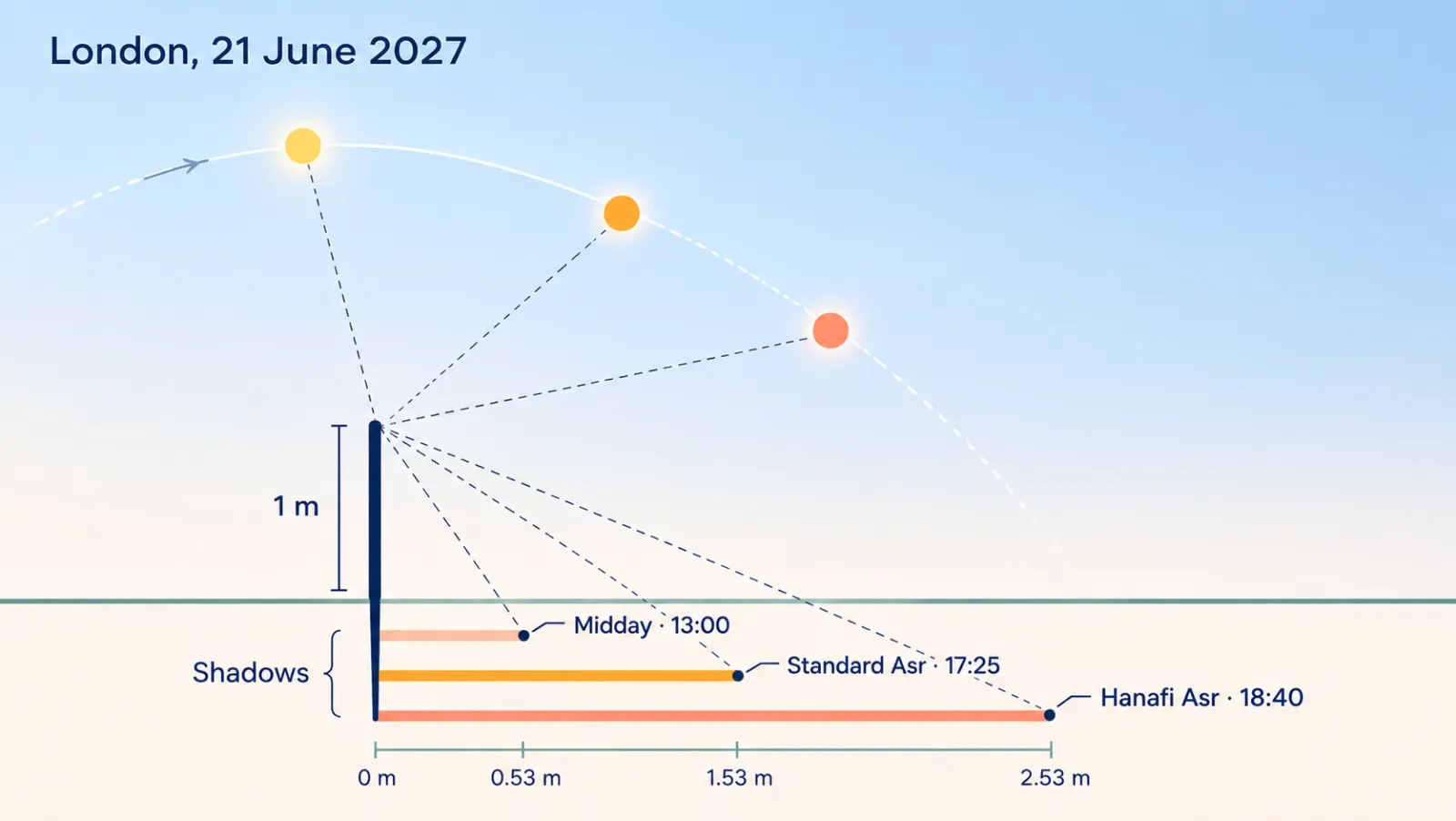
Take a stick one metre tall in London on 21 June 2027:
- Midday (Dhuhr): 13:00, with the sun 62° above the horizon and a shadow of 0.53 m
- Standard Asr: shadow 1 m + 0.53 m = 1.53 m, at 17:25
- Hanafi Asr: shadow 2 m + 0.53 m = 2.53 m, at 18:40
- Gap between them: 1 hour 15 minutes
The gap between the two times changes with the season. In winter the sun stays low, so the same stick's shadow is already 3.72 m long at midday. When the sun is that low, a small drop in the sky stretches the shadow a long way, so the extra metre comes in about half an hour. In summer the sun is high and a shadow lengthens slowly as it drops, so the gap passes an hour.
Because Asr depends only on the sun's height and the shadow rule you follow, your calculation method does not move it. Methods differ on the angles for Fajr and Isha, as explained in how prayer times are calculated. Here is how the two times move through the year in London:
| Date | Midday shadow | Standard Asr | Hanafi Asr | Gap |
|---|---|---|---|---|
| Winter, 21 Dec | 3.72 m | 13:38 | 14:07 | 30 min |
| Spring, 20 Mar | 1.26 m | 15:26 | 16:15 | 50 min |
| Summer, 21 Jun | 0.53 m | 17:25 | 18:40 | 75 min |
| Autumn, 22 Sep | 1.24 m | 16:12 | 17:02 | 50 min |
Why are there two Asr times?
The difference is clearest in one hadith, which the schools read in two ways. The Prophet ﷺ said that the angel Jibril led him in prayer twice at the Ka'bah. The first time, Jibril led Asr "when everything was similar (to the length of) its shadow". The second time, he led Dhuhr at that same moment, "at the time of Asr the day before", and Asr "when the shadow of everything was about twice as long as it". Jibril then said that the time is "between these two times" (Jami' at-Tirmidhi 149).
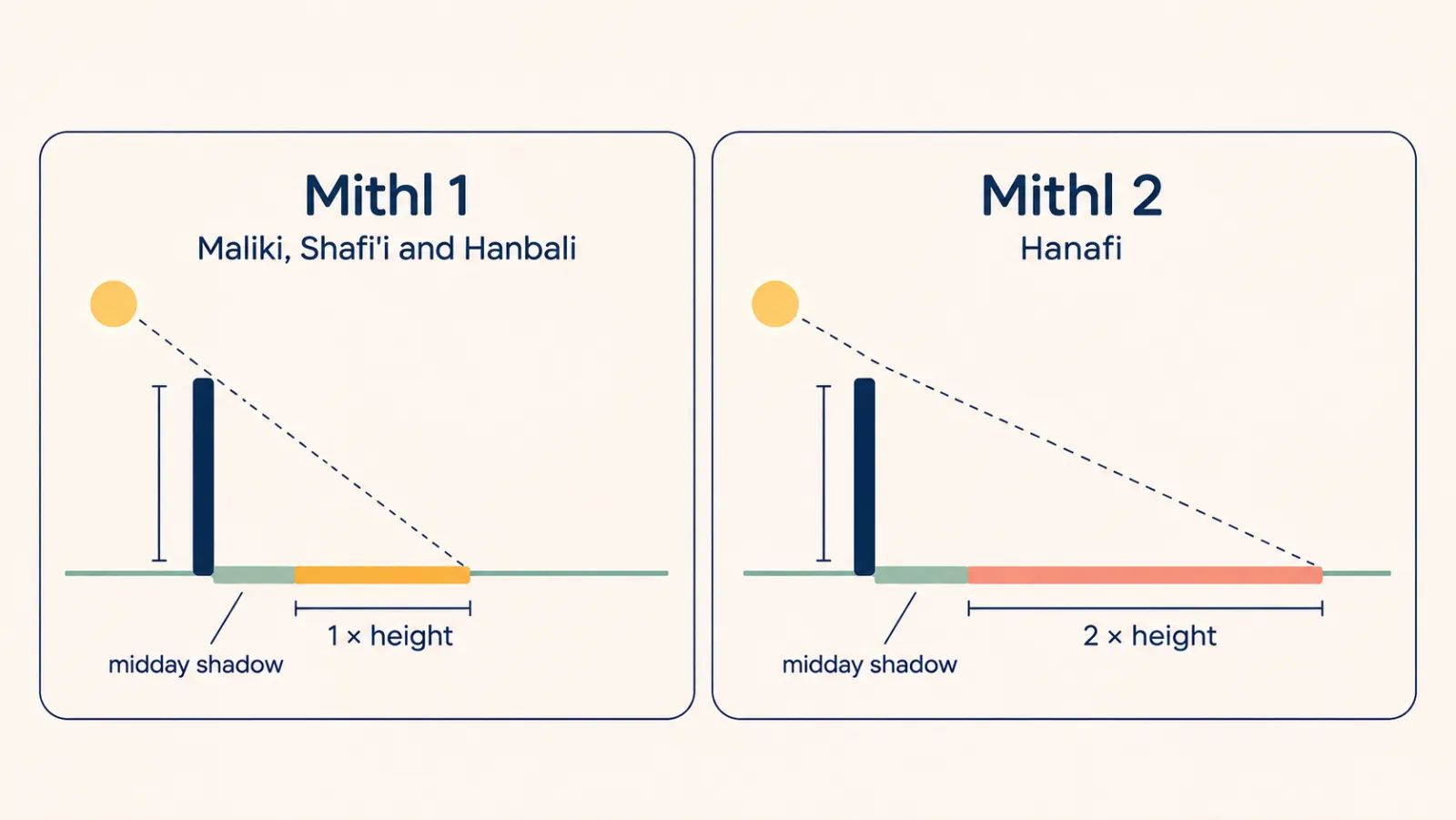
The majority view takes the first time as the start of Asr; the Hanafi school, in the position of Imam Abu Hanifa, takes the second:
- Maliki, Shafi'i and Hanbali
Asr begins when the shadow equals the object's length, plus the midday shadow: the first time Jibril led it. Imam Abu Hanifa's two students, Imam Abu Yusuf and Imam Muhammad, held the same view. - Hanafi
Asr begins when the shadow is twice the object's length, plus the midday shadow, because the second time, Jibril led Dhuhr at the moment the shadow equalled the object.
Many mosque timetables print both times, as "Mithl 1" and "Mithl 2" (mithl means "equal": one or two lengths of the object).
When does Asr end?
Asr ends at sunset, when the time of Maghrib enters. The Prophet ﷺ said that "whoever could get one rak'a of the 'Asr prayer before sunset, he has got the ('Asr) prayer" (Sahih al-Bukhari 579). He also said that "the time for the afternoon prayer is as long as the sun has not become pale" (Sahih Muslim 612d). Many scholars teach from this that Asr should not be delayed, without a reason, until the sunlight turns pale.
How do I find Asr where I am?
- Check your local mosque's timetable
Many list both Asr times; note which one your mosque follows. - Match the Asr setting in your app
Choose the standard or the Hanafi time so that your app agrees with the timetable you follow.

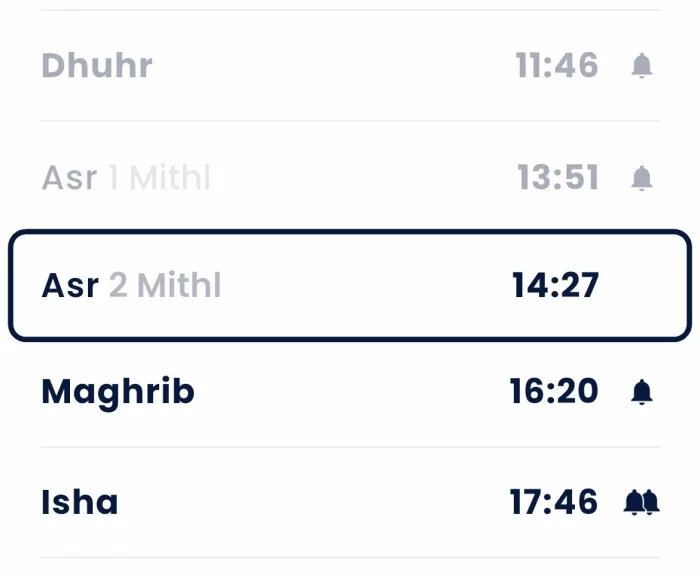
In Pillars, all of this is in Settings, under Prayer Times:
- Madhab / Asr Time
Choose Earlier Asr (Shafi'i, Maliki and Hanbali) or Later Asr (Hanafi). - Show Both Asr Mithl
Lists both Asr times on the prayer times screen. - Custom adjustments
Move Asr a few minutes earlier or later to match your mosque.
Keep reading