
Short answer. The five pillars of Islam are its five core acts of worship: the shahada (declaration of faith), salah (the five daily prayers), zakat (yearly charity), sawm (fasting in Ramadan) and hajj (pilgrimage to Mecca (Makkah), once in a lifetime if able). There is no sixth pillar; the "six" people mention are the articles of faith.Sahih al-Bukhari 8
The five pillars hold up Islam, the way columns hold up a roof.
What are the five pillars of Islam?
"Islam is based on (the following) five (principles)."
HadithThe Prophet ﷺ, narrated by Ibn Umar · Sahih al-Bukhari 8 and Sahih Muslim 16The Arabic word for pillar is rukn (plural arkan), the support of a building. The hadith of Jibril (Gabriel) names the same five, starting with the shahada, then prayer and zakat.Sahih Muslim 8
The order is how the Prophet ﷺ listed them, and the shahada and prayer always come first. The last two vary between narrations: in Sahih al-Bukhari, hajj is mentioned before fasting.Sahih al-Bukhari 8 In Sahih Muslim, when a listener repeats it with hajj first, Ibn Umar corrects him so the wording matches what he heard from the Prophet ﷺ: "the fasts of Ramadan precede the Pilgrimage."Sahih Muslim 16
| Pillar | What it is | How often |
|---|---|---|
| Shahada | Declaring there is no god but Allah and Muhammad is His messenger | Once to enter Islam, then daily |
| Salah | The five daily prayers, facing the Kaaba | Five times a day |
| Zakat | 2.5% of qualifying wealth, given to those in need | Once a year, above nisab |
| Sawm | Fasting from dawn to sunset | Every day of Ramadan |
| Hajj | Pilgrimage to Mecca in Dhul Hijjah | Once in a lifetime, if able |
How the five pillars fit together
The pillars move from belief to a whole life of practice. The shahada puts faith into words. Salah (prayer) turns it into a habit five times a day. Zakat and the Ramadan fast come round once a year, and hajj is a once-in-a-lifetime journey for those who can make it.
1. Shahada: the declaration of faith
The shahada is the declaration that there is no god but Allah and that Muhammad ﷺ is His messenger. In Arabic: ashhadu an la ilaha illa Allah, wa ashhadu anna Muhammadan rasul Allah.
Muslims say it because it is the centre of belief: everything else in the faith grows from that single idea. The Qur'an also says humankind was created to worship God (Qur'an 51:56), so the declaration is a promise to live with that purpose.
Said sincerely, with its meaning understood, it is how a person becomes Muslim. The Qur'an puts its first half as a command: "So, know ˹well, O Prophet,˺ that there is no god ˹worthy of worship˺ except Allah."Qur'an 47:19
It is the only pillar that is a statement rather than an action. Muslims repeat it in every prayer and in the call to prayer.Wikipedia
2. Salah: the five daily prayers
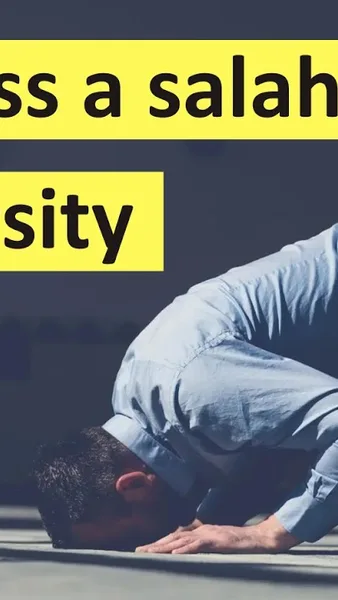
Salah is the ritual prayer a Muslim performs five times a day, facing the Kaaba in Mecca: Fajr (dawn), Dhuhr (midday), Asr (afternoon), Maghrib (sunset) and Isha (night).
Wherever a Muslim happens to be, prayer is the thing that stops the day. They pray because God commands it as a way to remember Him: "worship Me and establish prayer for My remembrance" (Qur'an 20:14). The Qur'an adds that prayer helps people turn away from wrongdoing (Qur'an 29:45), and tells believers to seek help through patience and prayer (Qur'an 2:45). For many Muslims it is a daily pause to reconnect.
The Qur'an says: "Indeed, performing prayers is a duty on the believers at the appointed times."Qur'an 4:103 Because the times follow the sun, they change every day and from place to place. You can look up prayer times for your city and the Qibla direction from wherever you are.
3. Zakat: giving 2.5% each year
Zakat is an obligatory payment of 2.5% of qualifying wealth, such as cash, savings, gold, silver and business stock, held for a full lunar year above a minimum called the nisab.
The word zakat is linked in Arabic with purifying and growing. The Qur'an uses exactly that idea: charity taken from wealth, "by which you purify them and cause them increase" (Qur'an 9:103). So Muslims give because they see wealth as a trust, and giving cleans the heart as well as helping others.
The nisab is commonly set at the value of 85 g of gold or 595 g of silver. Prices move, so check its value on the day your zakat is due.
The Qur'an names who may receive it: "Alms-tax is only for the poor and the needy," followed by six other groups. Qur'an 9:60 lists all eight:
- The poor (al-fuqara'): little or no income
- The needy (al-masakin): income doesn't cover basic needs
- Zakat workers (al-'amilin 'alayha): those who collect and distribute it
- Those whose hearts are to be reconciled (al-mu'allafati qulubuhum): new Muslims or those drawn closer to Islam
- Freeing captives (fir-riqab)
- People in debt (al-gharimin): can't repay debts taken on for lawful needs
- In the cause of Allah (fi sabilillah)
- The stranded traveller (ibn al-sabil): cut off from their money
4. Sawm: fasting in Ramadan
Sawm is fasting from dawn (Fajr) to sunset (Maghrib) every day of Ramadan, the ninth month of the Islamic calendar, which lasts 29 or 30 days depending on the sighting of the moon. The fast means no food, drink or marital relations during the day.
Ramadan is the month the Qur'an was first revealed, and that is a big part of why it is special. Muslims fast because God prescribed it, as He did for earlier communities (Qur'an 2:183), and the Qur'an stresses that God wants ease, not hardship (Qur'an 2:185).
The Qur'an says: "O believers! Fasting is prescribed for you," as it was for communities before, so that believers may become mindful of Allah.Qur'an 2:183
People who are ill or travelling can make up the days later.Qur'an 2:185 Those who can only fast with extreme difficulty can feed a needy person for each day instead,Qur'an 2:184 pregnant and breastfeeding women are excused,Abu Dawud 2408 and children do not have to fast before puberty.Abu Dawud 4403 See when Ramadan 2027 starts or the Ramadan timetable.
5. Hajj: the pilgrimage to Mecca
Hajj is the pilgrimage to the Kaaba in Mecca, required once in a lifetime of every adult Muslim who is physically and financially able.Sahih Muslim 1337 It takes place in Dhul Hijjah, the twelfth Islamic month, starting on the 8th, with the day of standing at Arafah on the 9th.
The Qur'an pictures people arriving "on foot and on every lean camel" from every distant pass (Qur'an 22:27). That is the call to pilgrimage, and Muslims still answer it. They go because hajj is a duty owed to God, a response to an invitation rather than a tourist trip.
The Qur'an says: "Pilgrimage to this House is an obligation by Allah upon whoever is able among the people."Qur'an 3:97 The hadith of Jibril gives the same condition: pilgrimage is for those who have more wealth than they need for the journey.Sahih Muslim 8 Anyone who cannot go is not at fault.
Is there a sixth pillar of Islam?
No. There are five pillars of Islam, and only these five are universally accepted.Wikipedia The "six pillars" people search for are almost always the six articles of faith, the pillars of Iman (arkan al-Iman): belief in Allah, His angels, His books, His messengers, the Last Day, and divine decree (qadar), good and bad.Sahih Muslim 8
Both lists come from the same conversation. In the hadith of Jibril, a man "dressed in pure white clothes" asked the Prophet ﷺ about Islam, and he listed the five pillars. Asked about Iman, he listed the six beliefs. Asked about Ihsan, he said: "That you worship Allah as if you are seeing Him, for though you don't see Him, He, verily, sees you."
Afterwards the Prophet ﷺ told Umar: "He was Gabriel (the angel). He came to you in order to instruct you in matters of religion."Sahih Muslim 8 The Qur'an names five of the six beliefs together in one verse.Qur'an 4:136
5 pillars of Islam
What a Muslim does
6 articles of faith
What a Muslim believes
Actions and beliefs: both lists come from the hadith of Jibril (Sahih Muslim 8).
How to practise the five pillars day to day
Day to day, most of the five pillars come down to prayer. A few habits help:
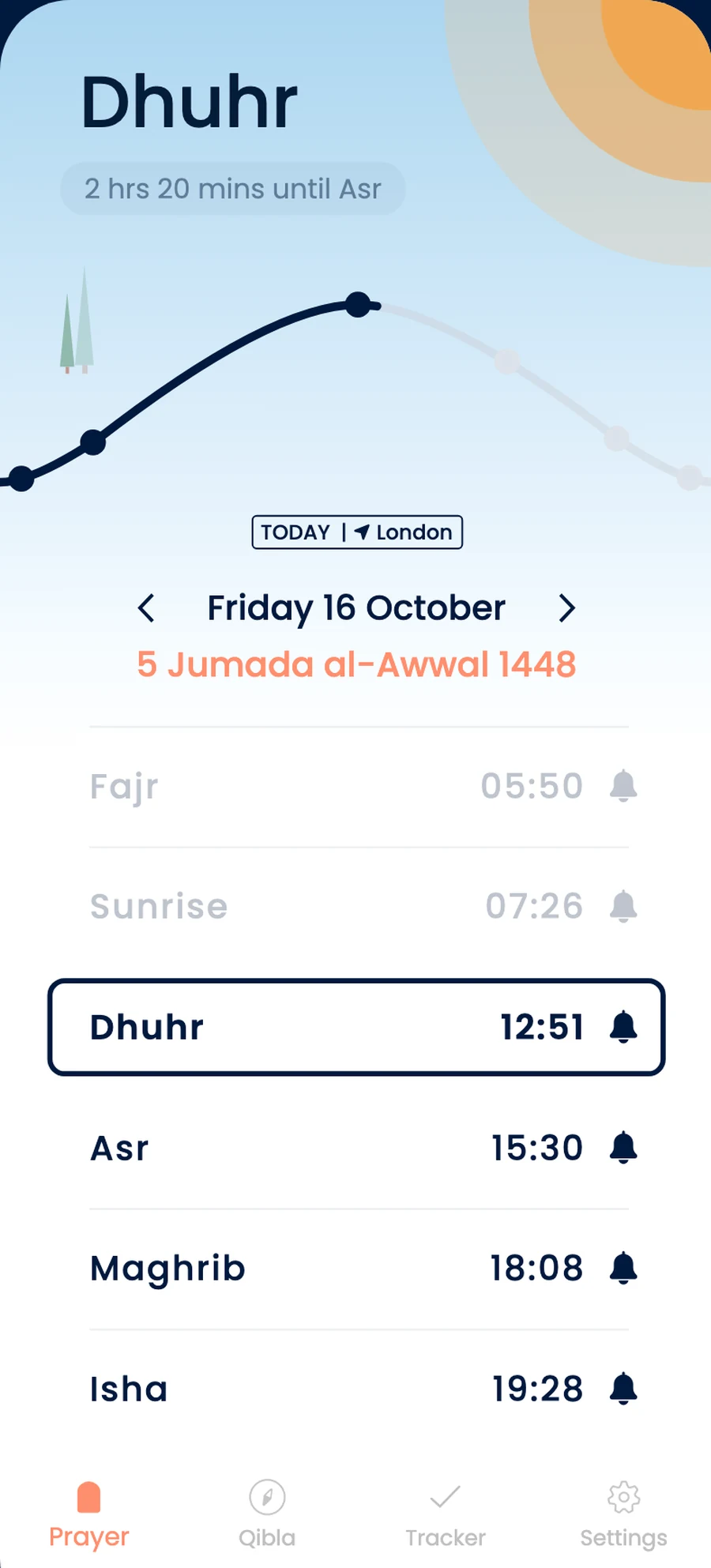
Salah. Know your five prayer times for where you are. A prayer times widget on your home screen keeps the next one in view.
Zakat. Pick one date each lunar year to check your savings against the nisab and pay what is due.
Sawm. Plan Ramadan with a local timetable for Fajr and Maghrib, and note any missed fasts to make up afterwards.
Hajj. If you are able, plan and save for it; if you are not, the obligation does not apply.
Keep up your daily prayers
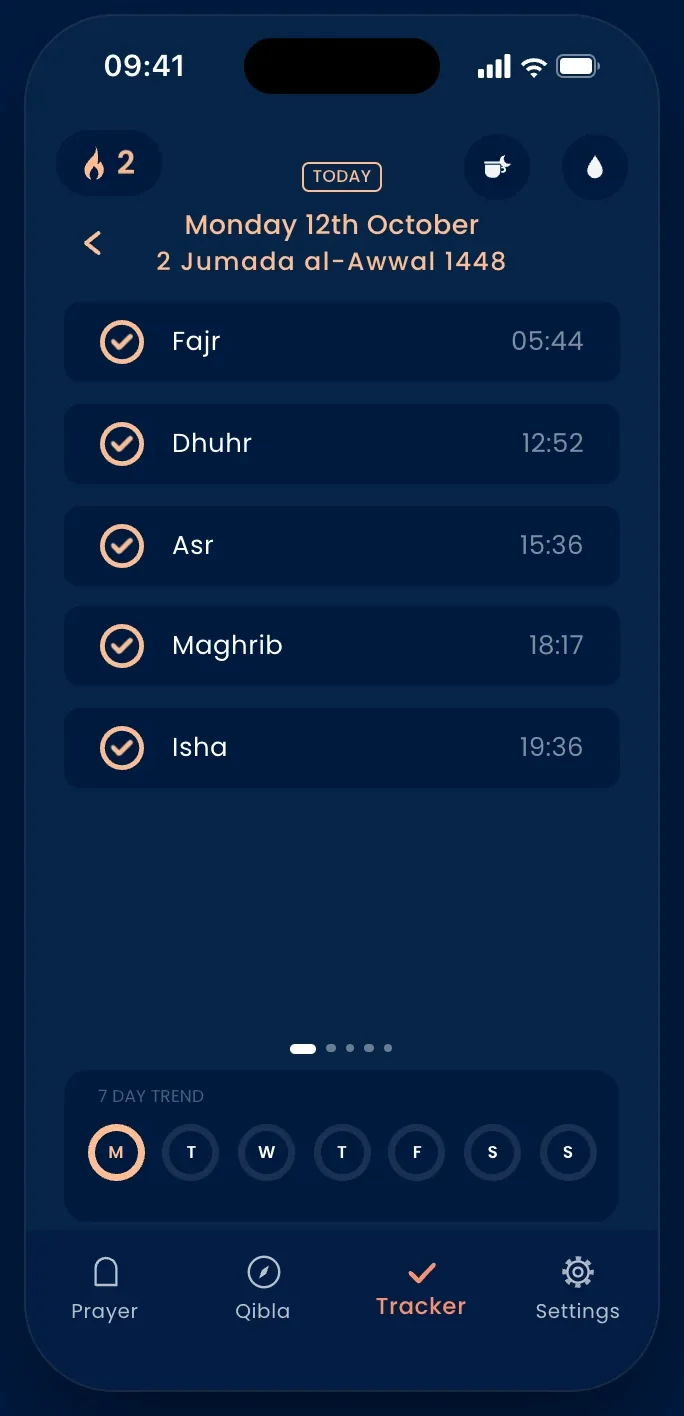
Pillars shows accurate prayer times for where you are, plays the adhan at each prayer and lets you track your prayers and fasts. Free, with no ads and no account needed.
Track Your PrayersFree on App Store and Google Play. No ads, no account.